Friday, November 8, 2013

Important Word Book for IBA, MBA, GMAT & GRE preparation

Important Word Book for IBA, MBA, GMAT & GRE preparation
Some screen short are given about this book.This book are very helpful who are eager to participate fodr BBA, MBA, GMAT & SET exam.
http://fs1.d-h.st/download/00082/zFL/My%20Words%20from%20Google%20Dictionary%20tanbircox.zip

Thursday, November 7, 2013

Ratio, Proportion & Partnership: Ration, Rule, Proportion, Rate, Partnership

Ratio: A ratio is a comparison of two quantities in the same units. We generally separate the two quantities in the ratio with a colon (:). Suppose, we want to write the ratio of 8 and 12. We can write this as 8 : 12 or as a faction 8/12
First term of a ratio is called antecedent, while the second term is known as consequent. Here, 8 is antecedent & 12 is consequent.
Rule: Multiplication or division of each term of a ratio by a same non-zero number does not affect the ratio.
Ratio of 8 & 12 = 8:12 = 8/12 = 4/6 = 2/3 = 10/15 = 14/21
i.e 8:12 = 4:6 = 2:3 = 10:15 = 14:21
3:4 = 2x3:4x2 = 6:8
10:5 = 10/5:5/5 = 12:1

Proportion: A proportion is an equation with a ratio on each side. It is a statement that two ratios are equal. Simply, the equality of two ratios is called proportion.
3/4 =6/8 or 3:4 = 6:8 is an example of proportion.
From 2/3 = 6/9
We can write, 2x9 = 3x6 [Cross-multiplication]

Rate: A rate is a ratio that expresses how long it takes to do something, such as traveling a certain distance. To walk 3 kilometers in one hour is to walk at the rate of 3 km/hr. The fraction expressing a rate has units of distance in the numerator and units of time in the denominator.

Ratio is a relationship: a number of people to a number of people; an amount of money to an amount of money.
<> A:B = 2:3; B:C = 3:4
:. A:B:C = 2:3:4
<> A:B = 2:3; B:C = 4:5
A:B = 2:3 = 2x4:3x4 = 8:12
B:C = 4:5 = 4x3: 5x3 = 12:15
:. A:B:C = 8:12:15

Partnership: Whenever two or more people involve in a business, invest their money and share profit according to the ratio of the ratio of their investment, partnership arises.

For example:
* A, B & C form a partnership & invest $60,000 $80,000 & $100,000 respectively. After one year, they receive $24,000 as profit. What will be the profit of each?

Explore: Ratio of investment
= 60,000 : 80,000 : 100,000
= 60 : 80 : 100
= 6 : 8 : 10
= 3 : 4 : 5
Sum of the numbers = 3+4+5 = 12
:. Profit of A = $24,000 x (3/12) = $6,000
Profit of A = $24,000 x (4/12) = $8,000
Profit of A = $24,000 x (5/12) = $10,000

*Divide 70 chocolates among girls & boys, where ratio of girls to boys is 3:4.

Explore: Ratio of girls to boys = 3:4
Sum of the terms = 3+4 = 7
:. Girls will get = 70 x (3/7) = 30 Chocolates
Boys will get = 70 x (4/70) =40 Chocolates

* 3:X = 2:6, X = ?

Explore: 3:X = 2:6
=> 3/X = 2/6
=> 3x6 = 2xX
=> X = 18/2 = 9
Answer: X = 9

Wednesday, November 6, 2013

Factors, Multiples, GCF & LCM: Part: 3 Exercise problem and solution

Question: 14 One-third, one-fourth, one-fifth and one-seventh of the human population of Island X, which has fewer than 5000 human inhabitants, are all whole numbers & their sum is exactly the population of island Y. What is the population of Island Y?
Option: (a) 4200 (b) 4279 (c) 4581 (d) 4800 (e) None of these
Explore: Since 1/3rd, 1/4th, 1/5th & 1/7th of the population are all whole numbers, hence, the total population must be a multiple of the LCM of 3, 4, 5 & 7.
LCM of 3, 4, 5, 7 = 3x4x5x7 = 12x35 = 420
Now, 5000/420 11(20/21). So, the largest number less than 5000, that is also a multiple of
420 is 420x11 = 4620
:. Population of Y = 4620 x (1/3 + 1/4 + 1/5 + 1/7) = 4620((105+140+84+62)/420) = 11x389 = 4279
Answer: (b)

Question: 15 Find the value of k if (X + 1) is a factor of X3+ kx + 3x3- 2.
Option: (a) 3.5 (b) 4 (c) 4.5 (d) 5 (e) None

Explore: Theoretically, we will have to determine what value of k makes (X3+ kx + 3x3- 2)/(x+1) an integer.
But doing so is very tough & is not possible within the time limit of the exam. So, we will try to plug in the values from the answer and see if it works.

First let, k = 4
:. X3+ kx + 3x3- 2
= X3+ 3x + 3x2 + 1 - 3 +x    
This is not divisible by (x + 1)
Let, k = 5
:. X3+ kx + 3x3- 2
= X3+ 3x + 3x2 + 1 - 3 + 2x
= (x+1)3+ 2x - 3
This too is not divisible by (x+1)
Even by trying k = 3.5 and k = 4.5 you will see that you cannot factorize it. So, (e) is the answer.

Question: 16 Suppose z = a x c x d x e where a > b > c > d > e. A decrease by 1 in which of the factors would result in the greatest decrease in the value of z?
Option: (a) a (b) b (c) c (d) d (e) e

Explore: To solve this problem, you think of multiplication as repeated addition. So, a reduction of 1 in any of the factors will reduce 1 addition. To make the maximum decrease, therefore, we have to reduce the addition of the largest term by 1.
The largest possible combination of 4 variables is given by a x b x c x d [:.a > b > c > d > e]
So, we need to reduce e by 1 to get  the greatest decrease in the value of z.
Now let us check this by using numbers.
e.g 6 > 5 > 4 > 3 > 2
6x5x4x3x2 = 720
6x5x4x3x1 = 360
6x5x4x2x2 = 480
6x5x3x3x2 = 540
6x4x4x3x2 = 576
5x5x4x3x2 =600

So, you see, reducing 2 to 1 gives the maximum reduction.
Answer: (e)

Question: 17 Which of the following is a factor of 12?
Option: (a) 24 (b) 40 (c) 18 (d) 4

Explore: Answer: (d) Factors of 12:2, 3, 4, 6, 12


Question: 18 Which of the following numbers is divisible by 2, 3, 5, 7?
Option: (a) 42 (b) 105 (c) 420 (d) 30 (e)None

Explore: Answer: (c) LCM of 2, 3, 5, 7 = 2x3x5x7 = 10x21 = 210
Since 420 = 2x210, So C is true.

Question: 19 Which of the following integers has the most divisors?
Option: (a) 88 (b) 91 (c) 95 (d) 99 (e) 101

Explore: 88 = 2x2x2x11
Its factors are 1, 2, 4, 8, 11, 22, 44, 88 = 8
91 = 7x13     :. Its factors are 1, 7, 13, 91 = 4 factors
95 = 5x19     :. Its factors are 1, 5, 95 = 3 Factors
99 = 3x3x11 :. Its factors are 1, 3, 9, 11, 33, 99 = 6 Factors
101 = 1x101 :. Its factors are 1, 101 = 2 factors
Answer: (a)

Please also check our first and second post:

Factors, Multiples, GCF & LCM: Exercise problem and solution

Factors, Multiples, GCF & LCM: Part: 2 Exercise problem and solution

Tuesday, November 5, 2013

Factors, Multiples, GCF & LCM: Part: 2 Exercise problem and solution

Question: 7 What is the minimum number of apples that must be added to the existing stock of 264 apples so that the total stock can be equally distributed among 6, 7 or 8 persons?
Explore: Since the apples need to be divided equally among 6, 7 or 8 people, first we calculate their LCM.
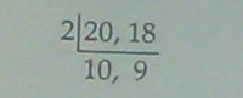
2/(6,7,8) = 3, 7, 4
:. LCM of 6, 7 or 8 = 2x3x7x4 = 168
 The division produces a reminder 96. To make this remainder 0, the minimum no. of apples that must be added
= 168 - 96
= 72
Answer : 72

Question: 8 It takes Russel 20 minutes to inspect a car and Sohel needs 18 minutes to inspect a car. They both start inspecting cars separately at 8.00 am. At certain points of time, both of them will finish inspecting a car at the same time. When will this occur for the first time?
Option: (a) 9.30 am (b) 9.42 am (c) 10.00 am (d) 11.00 am

Explore: Since we are looking for a time that is common to both the inspection, the time must be longer than both 20 & 18 min. We calculate their LCM.
LCM of 20 & 18 = 2x10x9 =180
180 minutes = 180/6 hours = 3 hours
:. After 3 hours they will finish inspecting at the same time i.e. at (8.00 am + 3 hrs) or 11.00 am.
Answer: (d)

Question: 9 What is the smallest number of apples that can be distributed equally among 4, 6, 9 or 15 students having a surplus of two apples each time?
Option: (a) 422 (b) 362 (c) 182 (d) 62 (e) None

Explore: First, let us find the number of apples that may be distributed equally among 4, 6, 9 or 15 students without any remaining. For that we have to calculate the LCM of these numbers.
4 = 2x2
6 = 2x3
9 = 3x3
15 = 3x5
:. LCM = 2x2x3x3x5 = 180
Now, according to the problem, we always have a surplus of 2 apples. Hence, the required number = 180 + 2 = 182
Answer: (c)

Question: 10 What is the largest number of apples not exceeding 440 that can be distributed among three persons in the proportions of 5:6:7?
Option: (a) 440 (b) 430 (c) 432 (d) 420

Explore: Since we want to divide the apples in the proportion 5:6:7, we need a number that is a common multiple of all of them. That is, we need that LCM to find out the least number of apples that may be distributed according to that proportion.
LCM of 5, 6, 7 = 5x6x7 = 210
Multiples of 210 are 210, 420,630 ....
:. Largest number not exceeding 440 is 420.
Answer: (d)

Question: 11 The greatest common factor of two positive integers is A. The least common multiple of the two numbers is B. If one of the number is C, then what is the other one?
Option: (a) ab/c (b) bc/a (c) a/c + b (d) a + b/c (e) None

Explore: We know,
Product of two numbers = (GCL x LCM) of the two numbers.
:. C x the other number = AxB
Or, the other number = AB/C
Answer: (A)

Question: 12 3 & 5 are factors of F. We can conclude that
Option: (a) 3x5 = F (b) 8 is a factor of F (c) F is a multiple of 15 (d) 3 & 5 are the only factors of F (e) 15 is a multiple of F

Explore: Since 3 & 5 are both factors F, we can conclude that,
f/(3x5) = N, where N is an integer.
Or, F = N x 15
So, (c) is definitely true. (A) is true only when N = 1. We cannot say anything about (b). D is false since 1 & F are also factors of itself. And again (e) is true only when N = 1
Answer: (c)

Question: 13 Which of the following must be an integer if x is a positive integer and (4/x) + (5/x) + (6/x) is also an integer?
Option: (a) x/5 (b) 5/x (c) x/30 (d) 30/x (e) None of these.

Explore: (4/x) + (5/x) + (6/x) = (4+5+6)/x = (15/x)
So, if 15/x is an integer, (15/x) x 2 will also be an integer.
(15/x) x 2 = 30/x
Answer: (d)

Please also check first and last Post:

Factors, Multiples, GCF & LCM: Exercise problem and solution

Factors, Multiples, GCF & LCM: Part: 3 Exercise problem and solution

Tuesday, October 29, 2013

Factors, Multiples, GCF & LCM: Exercise problem and solution

Factors, Multiples, GCF & LCM: Exercise problem and solution

Problem: 1 The difference between the number factors of 32 & 64 is?
Option: (a) 3 (b) 2 (c) 1 (d) 0 (e) None

Explore: Let us write down all the factors of 32 and 64
32 : 1, 2, 4, 8, 16, 32
64 : 1, 2, 4, 8, 16, 32, 64
:. 64 has 1 more factor than 32.
Answer: (c)

Problem: 2 What is the greatest number that divides 84, 144 or 18 without any remainder?
Option: (a) 18 (b) 12 (c) 24 (d) 6 (e) None

Explore: The question asks us to find the greatest common divider of 84, 144 & 18. First we will break them up into prime factors.
84 = 2x2x3x7
144 = 2x2x2x2x3x3
18 = 2x3x3
:. GCD = 2x3 = 6
Andwer: (d)

Problem: 3 Find the smallest number of oranges that can be distributed completely & equally among 4, 6, 10 or 18 children.
Option: (a) 16 (b) 60 (c) 240 (d) 180 (e) None

Explore: To be able to divide the oranges completely & equally among 4, 6, 10 or 18 children, we need to find a number that is completely divisible by all of 4, 6, 10 or 18. i.e. we have to find the LCM of these numbers.
4 = 2x2
6 = 2x3
10 = 2x5
18 = 2x3x3
:. LCM = 2x2x3x3x5 = 4x9x5 = 180
Answer: (d)

Problem: 4 What is the smallest integer having only three different odd factors?
Option: (a) 75 (b) 90 (c) 105 (d) 120 (e) None

Explore: Let us list the factors of each number & mark the odd ones.
75 : 1, 3, 5, 15, 25, 75 = 6 odd factors.
90 : 1, 2, 3, 5, 6, 9, 10, 15, 18, 30, 45, 90 = 6 odd factors
105 : 1, 3, 5, 7, 15, 21, 35, 105 = 8 odd factors
120 : 1, 2, 3, 4, 5, 6, 8, 10, 12, 15, 20, 24....... more than 3 odd factors.
:. All of the options have more than 3 odd factors.
Answer: (e)

Problem: 5 Find the largest number of apples not exceeding 1000 which can be divided among 6, 15, 20 or24 boys?
Option: (a) 990 (b) 960 (c) 930 (d) 900 (e)None

Explore: LCM of 6, 15, 20 & 24 = ?
6 = 2x3
15 = 3x5
20 = 2x2x5
24 = 2x2x2x3
:. LCM = 2x2x2x3x5 = 120
960 is a multiple of 120. So, that is the required largest number.
Answer: (b)

Problem: 6 A man has 72 green marbles and 108 red marbles. He decides to pack them into packets of the same size, each containing either all red or all green marbles. What is the maximum number of marbles he can put in each packet?

Explore: Since each packet is of the size, we have to find a number that divides both 72 & 108, & since we have been asked to gibe the greatest one, we need the GCF.
GCF of 72 & 108
= 2x2x3x3
=  36
:. Maximum number of marbles that can be put in each packet is 36

Please also check second and third post:

Factors, Multiples, GCF & LCM: Part: 2 Exercise problem and solution

Factors, Multiples, GCF & LCM: Part: 3 Exercise problem and solution

Monday, October 28, 2013

Factors, Multiples, GCF & LCM: Multiples, LCM

This is second part of Factors and Multiples discussion. For to see our first discussion Please click  on the link below.

Factors, Multiples, GCF & LCM : Factors, Prime Factorization, Factorization 


Multiples:  Multiples of a number are those which are divisible by the number.

Multiples of 2: 2, 4, 6, 8, 10, 12 .............

Multiples of 3: 3, 6, 9, 12, 15 .................

A number has an infinite number of multiples. But any number has a fixed & finite number of factors.

LCM:  Least common Multiple(LCM). A multiple is a always greater than or equal to the number white a factor is always less than or equal to the number.

Multiples of 4: 4, 8, 12, 16, 20, 24,28 ............

Multiples of 6: 6, 12, 18, 24, 30 .............

Common multiples of 4 & 6 are 12, 24, 36, ....

The least is 12.

:. LCM of 4 & 6 is 12

It can be shown by Venn Diagram also.

 Simplest way to find out LCM:

:. LCM of 4 & 6 = 2x2x3 = 12

Example: Find LCM of 6, 8, 12, 16.
:. LCM of 6, 8, 12, 16 = 2x2x2x3x2 = 48
The prime factorization may be used to calculate LCM also. Let us try to apply it to find out the LCM of 6, 8, 12, 16.

6 = 2x3
8 = 2x2x2
12 = 2x2x3
16 = 2x2x2x2

To calculate the LCM we take the maximum occurrence of each prime factor. For example, 2 is a prime factor. Its maximum occurrence is 4 times (in 16). the maximum time 3 occurs in any of the factors is 1 ( in 12 & 6). So, the LCM = 24 x 3 = 48.
Note: 48 is divisible by 6, 8, 12, 16.
Also multiples of 48 are divisible by 6, 8, 12 ,16.
i.e. 96, 144, 192, 240 ... are divisibel by 6, 8, 12, 16.

But since 48 is the smallest among all the common multiples, it is the LCM.
If P is divisible by Q, it is also divisible by the factors of Q i.e. if 90 is divisible by 30, 90 is divisible by factors of 30 (1, 2, 3, 5, 6, 10, 15)
Similarly, If P is a multiple of Q, any number R, that is a multiple of Q. For Example, 12 is a multiple of 6. So, 24, 36, 48 etc. Which are multiples of 12 are also multiples of 6.

Once Useful Formula: LCM x GCD = Product of the two numbers.
Example:
LCM of 12 & 20 = 60
GCD of 12 & 20 = 4
Here, product of the two numbers = 12 x 20 = 240
LCM x GCD = 60 x 4 = 240
:. LCM x GCD = Product of the two numbers.

For to see our first discussion please click on the link below:

Factors, Multiples, GCF & LCM : Factors, Prime Factorization, Factorization

Sunday, October 20, 2013

Factors, Multiples, GCF & LCM : Factors, Prime Factorization, Factorization

Factors: Factors of a number are those which can divide the number without remainder i.e. a number is divisible by its factors.
Factors of 12:1, 2, 3, 4, 6, 12
Factors of 30: 1, 3, 5, 6, 10 15, 30


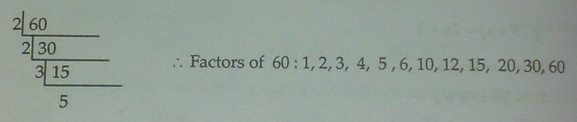
Prime Factorization: Every integer greater than 1 that is not a prime can be written as a product of primes. This is called its prime factorization.
e.g 60 = 2x2x3x5 is the prime factorization of 60. But 60 = 4x15 is not prime factorization.

Factorization: When a integer is expressed as the product of its factor, we say that the number has been factorized and the expression is called factorization. So, in 90 = 9x10, 90 has been factorized and (9x10) is the factorization.
From the given examples you may think that factorization is an easy process. But actually, it can be very tough. Given an unfamiliar number (e.g 327531913) it is very tough to find out its factorization. As the number gets bigger & bigger (300 digit) it becomes practically impossible to factorize it. This property of factorization is used in cryptography to provide security in computer systems.

GCF: Greatest Common Factor
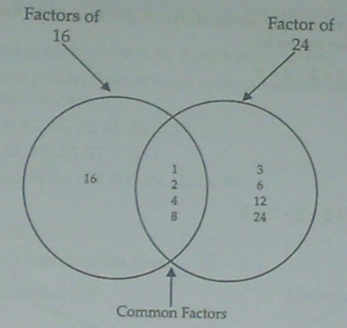
Factor of 16: 1, 2, 4, 8, 16
Factor of 24: 1, 2, 3, 4, 6, 8, 12, 24
Common factor of 16 and24 are 1, 2, 4, 8
The greatest is 8
:. GCF (Greatest Common Factor) is 8
It can be sown by Venn Diagram also.


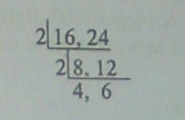
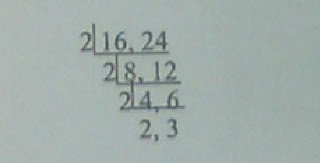
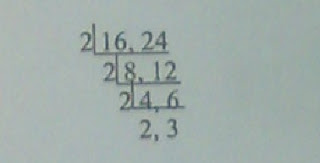
Simplest way to find out GCF: We will try to illustrate the process by giving an example. Let us try to determine the GCF of 16 & 24
Step 1:  Let us write the numbers side by side like this 16, 24
Now we try to find any small integer that will divide both these numbers. We can easily see that both 16 & 24 are even numbers. So, we choose 2 as our divisor.
Step 2:  Now again we try find a common divisor for 8 & 12. So
This process continues till the numbers in the bottom are relatively prime (i.e they have no common divisor). So, we have
Step 3:  To get the GCF we multiply all the common divisors. Note that the common divisors are written on the left.
:. GCF of 16 & 24 = 2x2x2 = 8

 :. GCF of 16 & 24 = 2x2x2 = 8
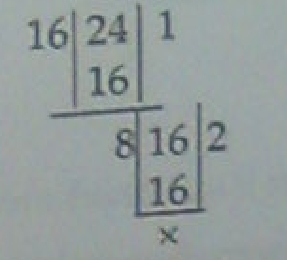
Another way:
:. GCF of 16 & 24 = 8
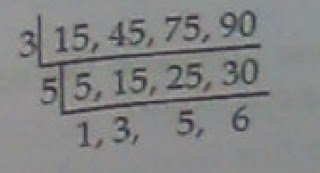
Example: Find GCF of 15, 45, 75 & 90.
:. GCF of 15, 45, 75 & 90 = 3x5 = 15

If you find this difficult you can use the prime factorization method. For example, let us try to determined the GCF of 15, 45, 75 & 90.
We will find write down the prime factorization of all the numbers.
15 = 3x5
45 = 3x3x5
75 = 3x5x5
90 = 3x3x2x5
Observe that all the prime factorizations contain at least one '3' & one '5'. So, the GCF = 3x5 = 15

For to see our second lecture Please click on the link below:

Factors, Multiples, GCF & LCM: Multiples, LCM

Thursday, October 17, 2013

Number System: Long Division

Long Division

Below is the process written out in full.
You will often see other versions, which are generally just a shortened version of the process below
.
You can also see this done in Long Division Animation.
Let's see how it is done with:
  • the number to be divided into is known as the dividend
  • The number which divides the other number is known as the divisor
And here we go:

4 ÷ 25 = 0 remainder 4 The first digit of the dividend (4)
is divided by the divisor.
  The whole number result is placed at the top. Any remainders are ignored at this point.
25 × 0 = 0 The answer from the first operation is multiplied by the divisor. The result is placed under the number divided into.
4 – 0 = 4 Now we subtract the bottom number from the top number.
  Bring down the next digit of the dividend.
42 ÷ 25 = 1 remainder 17 Divide this number by the divisor.
  The whole number result is placed at the top. Any remainders are ignored at this point.
25 × 1 = 25 The answer from the above operation is multiplied by the divisor. The result is placed under the last number divided into.
42 – 25 = 17 Now we subtract the bottom number from the top number.
  Bring down the next digit of the dividend.
175 ÷ 25 = 7 remainder 0 Divide this number by the divisor.
  The whole number result is placed at the top. Any remainders are ignored at this point.
25 × 7 = 175 The answer from the above operation is multiplied by the divisor. The result is placed under the number divided into.
175 – 175 = 0 Now we subtract the bottom number from the top number.
    There are no more digits to bring down. The answer must be 17

Number System: Dividing Decimals

Dividing Decimals

Quick method: use Long Division without the decimal point,
then re-insert the decimal point in the answer.

Dividing a Decimal Number by a Whole Number

To divide a decimal number by a whole number:
  • Use Division or Long Division (ignoring the decimal point)
  • Then put the decimal point in the same spot as the dividend (the number being divided)

Example: Divide 9.1 by 7

Ignore the decimal point and use Long Division:

   13
7 )91
   9
   7
   21
   21
    0

Put the decimal point in the answer directly above the decimal point in the dividend:

   1.3
7 )9.1
The answer is 1.3

Dividing by a Decimal Number

But what if you want to divide by a Decimal Number?
The trick is to convert the number you are dividing by to a whole number first, by shifting the decimal point of both numbers to the right:
move decimals
Now you are dividing by a whole number, and can continue as normal.
It is safe to do this if you remember to shift the decimal point of both numbers the same number of places.

Example: Divide 6.4 by 0.4

You are not dividing by a whole number, so you need to move the decimal point so that you are dividing by a whole number:
move 1
6.4 64
0.4 4
move 1
6.4/0.4 is exactly the same as 64/4,
as you moved the decimal point of both numbers.

And the answer is:
64 / 4 = 16

You can see for yourself how many 0.4s make 6.4:


Example: Divide 5.39 by 1.1

Move the decimal point so that you are dividing by a whole number:
move 1
5.39 53.9
1.1 11
move 1
You are now dividing by a whole number, so you can proceed:
Ignore the decimal point and use Long Division:
    049
11 )539
    5
    0
    53
    44
     99
     99
      0
Put the decimal point in the answer directly above the decimal point in the dividend:
    04.9
11 )53.9

The answer is 4.9

Animations

Have a look at these Decimal Division Animations for further help.


Lastly ...

As a final check you can put your "common sense" hat on and think "is that the right size?", because you don't want to pay ten times too much for anything, nor do you want to get only one-tenth of what you need!

Related Posts Plugin for WordPress, Blogger...

Labels

Absolute Value Abstract Algebra Adding and Subtracting Decimals Addition in Columns Age Related Problem Algebra Algebra Number Theory Analyzing Sequence Arithmetic Mean Arithmetic Progression Brain Game Calculus Book Download Central Tendency Commutative Algebra Complex Variables Convert Fractions to Percents Convert Percents to Decimals Convert Percents to Fractions Counting Counting & Venn Diagram Decimal Number Decimals to Fraction Decimals-Fractions- Percentages Dicimal Number Differential Equation free book download Dispersion Dividing By Zero Dividing Decimals Divisibility Rules Equation Equation & Inequality Even and Odd Numbers Exercise (Counting & Venn Diagram) Exercise (Equation & Inequality) Exercise Problem Exercise(Equation & Inequality) Exponent & Logarithms Factorial Function Factorization Factors For computer Fractions Fractions to Decimal Free Book Free Math Book Download GCF General Representation of odd & even integer Geometric Mean Geometric progression Harmonic Mean Important Properties of number Line Inequalities Integer Introduction to Decimal LCM Linear Algebra Long Division Making a systematic List Math Software Download Math Tricks Measure of Variability Median Mixed Fractions Mode Multiples Multiplying Decimals N-th Term Natural Number Next Number of the series Number Line Number Sequence Number System Odd & Even Integers Ordering Decimals Ordering Numbers Partnership Photo Galary Place Value Preface Prime Factorization Prime Number Probability Proportion Quadratic equation Ratio Rational & Irrational Numbers Real Analysis book Download Real Number Remember Numbers Simplifying Fractions Solutions to Problems Solving equations Statistics Subtracting Decimals Summation of N term of Geometric Summation of N term of arithmetic Systems of liner equations The counting principle Time & work Using arithmetic to count Venn Diagram Whole Numbers Zero Zoomable Number Line

 
Design by Free WordPress Themes | Bloggerized by Lasantha - Premium Blogger Themes | Web Hosting Bluehost